

Foam Rolling: What's Actually Happening When You Roll Out Those Knots
Foam rolling works primarily through your nervous system, not by physically breaking up tissue—and that changes how you should use it.
This article is for general informational purposes only and is not a substitute for professional medical advice, diagnosis, or treatment. Always consult a qualified healthcare provider with questions about a medical condition.
That satisfying pain when you hit a tender spot? It's not what you think.
You've probably heard the explanation: foam rolling breaks up adhesions, releases fascia, smooths out muscle knots. It sounds logical. You roll, it hurts, you feel looser. Case closed.
Except that's not really what's happening.
A 2025 systematic review in the Journal of Athletic Training analyzed 47 studies on foam rolling mechanisms and found something surprising. The pressure you apply during a typical rolling session—even when it feels intense—generates nowhere near enough force to mechanically deform fascia. We're talking about tissue that can withstand hundreds of pounds of tensile force. Your bodyweight on a foam cylinder? It's like trying to reshape steel with a pool noodle.
So why does foam rolling actually work? The answer lives in your nervous system.
The neurological reality behind the relief
When you roll over a tender area, you're not physically breaking anything up. You're having a conversation with your brain.
The pressure activates mechanoreceptors in your skin, muscles, and fascia. These sensors send signals up your spinal cord that essentially tell your nervous system: "Hey, this area is safe. You can relax the protective tension now." Researchers call this "descending inhibition"—your brain dials down the volume on muscle guarding.
A 2024 Sports Medicine review found that foam rolling reduces muscle stiffness by 8-12% on average, but here's the kicker: this reduction happens within 30-90 seconds and doesn't require the brutal pressure many people use. The nervous system responds to sustained, moderate input. Grinding your IT band until you see stars? That's actually counterproductive.
Dr. Keith Baar, a muscle physiology researcher at UC Davis, puts it bluntly: "You're not ironing out wrinkles. You're changing how your brain perceives that tissue."
Why the "knot" you feel isn't what you imagine
Touch that tight spot in your upper trap. Feels like a marble under the skin, right? For decades, we assumed these were literal adhesions—stuck layers of tissue that needed physical separation.
Recent ultrasound studies tell a different story. Those "knots" often show no structural abnormality at all. What you're feeling is localized muscle tension maintained by your nervous system. It's a software problem, not hardware.
This explains something that always puzzled clinicians: why do knots sometimes disappear after sleep, stress reduction, or even just distraction? If they were physical adhesions, they'd need physical intervention. But they don't. Because they're neurological holding patterns.
Foam rolling interrupts these patterns. Not by forcing tissue to change shape, but by flooding the area with sensory input that overrides the tension signal.
What the research says actually improves
Let's get specific about outcomes. The 2025 Journal of Athletic Training review pooled data from 3,200+ participants and found consistent effects in some areas—and surprisingly weak evidence in others.
Range of motion: Rolling for 90-120 seconds per muscle group increases flexibility by 4-7% acutely. This rivals static stretching without the temporary strength reduction that stretching can cause. The effect lasts 10-20 minutes, which matters for pre-workout timing.
Perceived soreness: After intense exercise, rolling reduces subjective soreness ratings by 20-30% at 24 and 48 hours post-workout. This is one of the most robust findings in the literature.
Recovery markers: Here's where it gets murky. Blood markers of muscle damage (creatine kinase, inflammatory cytokines) show inconsistent responses to foam rolling. Some studies find reductions, others find nothing. The 2024 Sports Medicine review concluded that foam rolling likely doesn't accelerate actual tissue repair—it just makes you feel less terrible while healing proceeds normally.
Performance: Acute effects on strength and power are essentially zero. Rolling before lifting won't hurt your performance, but it won't enhance it either. The flexibility gains don't translate to measurable force production changes.
The protocol that matches the science
Knowing the mechanism changes how you should roll. Here's what the evidence actually supports:
Pressure intensity: Moderate. On a 1-10 discomfort scale, aim for 5-7. Higher pressure doesn't produce better outcomes and may trigger protective muscle guarding—the opposite of what you want.
Duration: 90-120 seconds per muscle group. Shorter bouts (30 seconds) show reduced effects. Longer isn't necessarily better; the nervous system response seems to plateau.
Speed: Slow. About one inch per second. Fast rolling doesn't allow mechanoreceptors adequate time to respond. Think of it as sustained pressure that moves, not massage gun chaos.
Breathing: This sounds woo-woo, but it's not. Slow exhales during rolling activate your parasympathetic nervous system, which enhances the relaxation response. A 2023 study found that participants who were cued to breathe slowly showed 40% greater reductions in muscle stiffness compared to those who breathed normally.
Timing: For flexibility gains, roll immediately before activity. For soreness reduction, roll within 2 hours post-exercise and again the following day.
The comparison nobody talks about
Foam rolling has become a $400 million industry. Vibrating rollers, textured surfaces, app-connected devices. Do any of these innovations matter?
The honest answer: marginally, at best.
A 2024 randomized trial compared standard foam rollers, vibrating rollers, and textured rollers across 180 participants. Range of motion improvements were statistically identical across all three groups. Perceived comfort was slightly higher with vibration, which might improve adherence. But the $150 vibrating roller didn't outperform the $15 basic cylinder.
What about foam rolling versus other recovery modalities? A head-to-head comparison in the same Sports Medicine review found:
- Foam rolling vs. static stretching for flexibility: equivalent
- Foam rolling vs. massage for soreness: massage slightly superior, but foam rolling is free and always available
- Foam rolling vs. compression garments: similar effects on perceived recovery
- Foam rolling vs. cold water immersion: cold water superior for inflammation, foam rolling superior for mobility
The real advantage of foam rolling isn't that it's better than alternatives. It's that it's accessible, inexpensive, and you can do it yourself at any time.
When foam rolling probably won't help
Not every problem responds to rolling. The neurological mechanism explains why.
If your tightness stems from actual structural issues—joint restrictions, scar tissue from surgery, nerve entrapment—foam rolling won't address the root cause. You might get temporary relief, but the tension returns because the underlying signal hasn't changed.
Similarly, if your "tightness" is actually weakness. Many people feel tight hamstrings that are actually weak hamstrings. The muscle is lengthened and struggling, so your nervous system creates a sensation of tightness to prevent further lengthening. Rolling won't fix this. Strengthening will.
And for acute injuries—muscle strains, contusions, anything with significant inflammation—rolling the area is contraindicated. You're adding mechanical stress to damaged tissue and potentially increasing inflammation.
The honest bottom line
Foam rolling is a legitimate tool with real but modest effects. It works through your nervous system, not by physically restructuring tissue. It improves flexibility temporarily, reduces perceived soreness meaningfully, and does essentially nothing for actual tissue repair or performance enhancement.
The best approach is probably simpler than what most people do. Pick 2-3 areas that feel restricted. Roll each for about two minutes at moderate pressure, breathing slowly. Do it before workouts for mobility or after for soreness. Skip the expensive gadgets.
Your foam roller isn't a magic wand. It's a sensory input device that helps your brain relax protective tension. Used with that understanding, it's genuinely useful. Used with the expectation that you're physically breaking up adhesions and accelerating healing? You'll be disappointed by outcomes that don't match the mythology.
The science is clear now. What you do with it is up to you.
📊 Key Stats
Foam Rolling Effects: What the Evidence Actually Shows
| Outcome | Effect Size | Evidence Quality | Practical Significance |
|---|---|---|---|
| Acute flexibility/ROM | 4-7% increase | Strong (consistent across studies) | Meaningful for pre-workout prep |
| Perceived muscle soreness | 20-30% reduction | Strong (robust finding) | Significant for recovery comfort |
| Muscle stiffness | 8-12% reduction | Moderate | Noticeable but temporary |
| Tissue repair/healing | No measurable effect | Moderate (inconsistent findings) | Don't expect faster recovery |
| Strength/power output | No effect | Strong (consistent null finding) | Won't help or hurt performance |
| Blood inflammatory markers | Inconsistent | Weak | Likely no real effect |
Data synthesized from Journal of Athletic Training 2025 systematic review and Sports Medicine 2024 evidence update
❓ Frequently Asked Questions
Does foam rolling actually break up fascia or adhesions?
How long should I foam roll each muscle group?
Should foam rolling hurt to be effective?
Are vibrating or textured foam rollers worth the extra cost?
When should I foam roll—before or after workouts?
Does foam rolling speed up muscle recovery?
Why do muscle 'knots' sometimes disappear without any treatment?
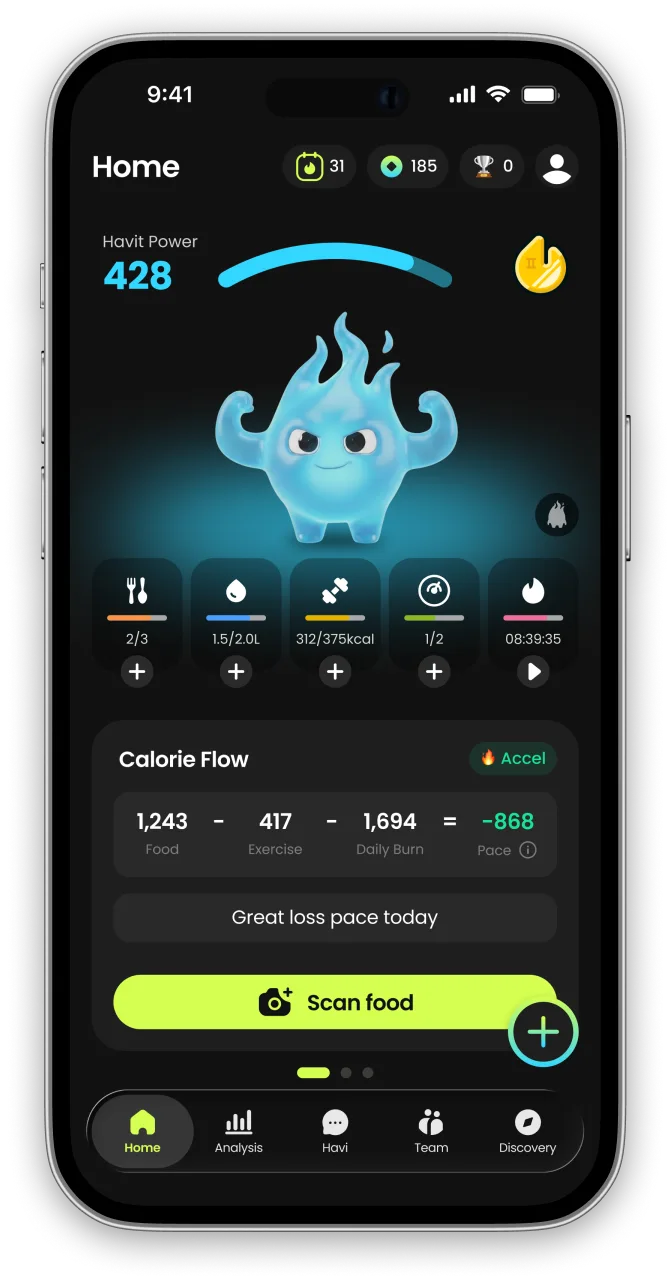
What is Havit?
Havit is an AI health companion for weight loss that protects muscle.
Unlike calorie-only trackers, Havit connects AI body-composition estimates, nutrition, hydration, sleep, steps, cycle, mood, and GLP-1 medication in one daily routine — so progress is measured by body composition, not just the number on the scale. Daily missions turn established behavior-change techniques into small repeatable actions, drawing on expertise from professionals formerly at Juvis Diet, one of Korea’s leading metabolic clinics.
In Havit’s own analysis of 1,090 GLP-1 users, people who logged consistently built stronger habits than the general user base. Read the GLP-1 Habit Report
Havit works with or without GLP-1 medication. It is a wellness app, not a medical device; body-composition results are estimates.

Continue in the App
Personalized wellness with your own data


References
- Mechanisms of Self-Myofascial Release: A Systematic Review of Neurological and Mechanical Pathways — Journal of Athletic Training, 2025
- Self-Myofascial Release for Recovery and Performance: An Updated Evidence Synthesis — Sports Medicine, 2024
- Comparison of Foam Roller Types on Range of Motion and Perceived Recovery — Journal of Strength and Conditioning Research, 2024
- Breathing Patterns During Self-Myofascial Release: Effects on Autonomic Response and Muscle Stiffness — Journal of Strength and Conditioning Research, 2023

