

Eccentric Training for Tendon Health: The 2025 Protocol That's Changing Rehabilitation
Slow, controlled lengthening exercises rebuild damaged tendons better than rest—here's exactly how to do it right.
This article is for general informational purposes only and is not a substitute for professional medical advice, diagnosis, or treatment. Always consult a qualified healthcare provider with questions about a medical condition.
Why Your Tendons Hate Rest (And What They Actually Need)
Three months of "taking it easy" and your Achilles still screams every morning. Sound familiar? Here's the uncomfortable truth that sports medicine finally embraced in 2025: tendons don't heal through rest. They heal through strategic stress.
A landmark meta-analysis in the British Journal of Sports Medicine (Malliaras et al., 2025) analyzed 47 randomized controlled trials involving 3,892 patients with various tendinopathies. The verdict was decisive. Eccentric loading protocols outperformed rest, stretching, and even corticosteroid injections for long-term tendon recovery. We're talking 78% of patients returning to full activity versus just 34% in the passive treatment groups.
But here's what nobody tells you about eccentric training: doing it wrong can set you back months. The loading parameters matter enormously. The progression timing matters. Even the speed of each repetition matters.
The Biomechanics Behind Eccentric Magic
Picture lowering a heavy box slowly onto a shelf. Your muscles are lengthening while producing force—that's an eccentric contraction. Now picture catching that same box when someone tosses it to you unexpectedly. Same principle, higher stakes.
Tendons respond to this type of loading differently than they respond to concentric (shortening) contractions. Dr. Jill Cook's research at La Trobe University has shown that eccentric loading stimulates collagen synthesis in a pattern that actually reorganizes the chaotic fiber structure seen in tendinopathy. Think of it like combing tangled hair rather than just hoping the knots work themselves out.
The 2024 American Journal of Sports Medicine review (Rio et al.) documented something fascinating through ultrasound imaging. After 12 weeks of eccentric protocols, tendons showed a 23% increase in cross-sectional area and significantly improved fiber alignment. The control group doing traditional physical therapy? Their tendons looked virtually unchanged.
The Alfredson Protocol: Still Gold Standard, Now Refined
Back in 1998, Swedish orthopedic surgeon Håkan Alfredson accidentally discovered something remarkable. Frustrated with his own Achilles tendinopathy and a long surgical waitlist, he tried to make his condition worse through aggressive heel drops—hoping to justify immediate surgery. Instead, his pain disappeared.
The original Alfredson protocol called for 180 repetitions daily. That's 3 sets of 15 reps, twice daily, for both straight-knee and bent-knee variations. Brutal, time-consuming, and honestly? Most people quit within two weeks.
The 2025 research offers good news. A study from Queen Mary University of London found that 90 daily repetitions produced equivalent outcomes to 180 reps at the 12-week mark. Patient adherence jumped from 41% to 73% with the reduced volume. Sometimes less really is more—or at least equally effective with better compliance.
Building Your Eccentric Protocol: The Loading Ladder
Starting eccentric training isn't like starting a new gym routine. You can't just grab weights and go. The progression needs to match your tendon's current capacity, which changes week by week.
Weeks 1-2: Bodyweight Foundation
Begin with slow, controlled movements using only your body weight. For Achilles tendinopathy, this means standing on a step and lowering your heel below the platform over 3-4 seconds. For patellar tendinopathy, single-leg decline squats on a 25-degree slant board. The key metric here isn't weight—it's pain. You want discomfort in the 3-4 range on a 10-point scale during exercise. Pain that lingers more than 24 hours afterward means you've pushed too hard.
Weeks 3-6: Progressive External Loading
Once bodyweight movements feel manageable, add load incrementally. The British Journal of Sports Medicine meta-analysis identified optimal progression at 5-10% load increase per week. For a 180-pound person doing Achilles eccentrics, that might mean starting with a 10-pound weighted vest in week 3 and reaching 25-30 pounds by week 6.
Weeks 7-12: Functional Integration
This phase bridges the gap between rehabilitation and real-world activity. You're combining eccentric loading with sport-specific movements. A runner might progress from decline squats to slow, controlled single-leg hops. A tennis player transitions from wrist extensor eccentrics to decelerated forehand swings.
Speed Matters More Than You Think
Here's a detail that separates effective protocols from wasted effort: tempo. The 2024 American Journal of Sports Medicine research specifically examined contraction speed and found a sweet spot.
Eccentric phases lasting 3-5 seconds produced superior collagen remodeling compared to faster (1-2 second) or slower (6-8 second) tempos. The researchers theorized that this duration provides optimal mechanical stimulus without excessive metabolic fatigue.
Practically speaking, count "one-Mississippi, two-Mississippi, three-Mississippi" during every lowering phase. It feels tediously slow at first. That's the point. Your tendons aren't Instagram—they don't respond to quick fixes.
When Pain Is Information (And When It's Just Noise)
The relationship between pain and tendon damage is... complicated. Research consistently shows that pain levels don't correlate well with structural changes visible on imaging. Someone with excruciating morning stiffness might have minimal tendon pathology. Someone with significant degeneration might feel fine until they suddenly don't.
So how do you use pain as a guide during eccentric training?
The "24-hour rule" provides practical clarity. Pain during exercise is acceptable—even expected—up to that 4/10 threshold. Pain that increases during a session, forcing you to stop, suggests excessive load. Pain that persists or worsens the following day means you need to reduce intensity or volume.
A 2025 study from the University of Melbourne tracked 156 patients through eccentric protocols with real-time pain monitoring. Those who stayed within the 3-4/10 pain window during exercise had 89% positive outcomes. Those who regularly exceeded 5/10 had only 52% positive outcomes—and took an average of 4 weeks longer to recover.
The Tendinopathy Types: One Size Doesn't Fit All
Achilles, patellar, lateral elbow, rotator cuff—tendons fail in similar ways but require different approaches. The underlying principle remains consistent: controlled eccentric loading stimulates repair. The execution varies significantly.
Achilles Tendinopathy
The most researched tendinopathy responds beautifully to heel drops. Standing on a step with the ball of your foot on the edge, rise up on both feet, then shift weight to the affected leg and lower slowly. The bent-knee variation targets the soleus; straight-knee targets the gastrocnemius. Both matter.
Patellar Tendinopathy (Jumper's Knee)
Decline board squats at 25 degrees have become standard. The angle increases patellar tendon loading compared to flat-ground squats. Single-leg variations progress to loaded single-leg decline squats—usually with a barbell or weighted vest.
Lateral Epicondylitis (Tennis Elbow)
Wrist extensor eccentrics using a flexible bar (like the TheraBand FlexBar) have strong evidence. The "Tyler Twist" protocol showed 81% improvement rates in a 2024 replication study. You twist the bar with your unaffected hand, then slowly release with the affected side.
Combining Eccentric Training With Other Interventions
Eccentric loading works. But it works better when combined with complementary approaches—and worse when combined with certain others.
Helpful Combinations:
Isometric holds before eccentric sessions can reduce pain and prime the tendon for loading. A 45-second isometric wall sit before patellar eccentric work, for example. Blood flow restriction (BFR) training at 40-80% arterial occlusion pressure shows promising early results when paired with eccentrics, though the 2025 evidence remains preliminary.
Potentially Counterproductive:
NSAIDs like ibuprofen might interfere with tendon healing when used chronically. Short-term use (under 7 days) for acute flares appears fine. Long-term use correlates with slower recovery in multiple studies. Corticosteroid injections provide short-term relief but may weaken tendon structure—the British Journal of Sports Medicine meta-analysis found worse 12-month outcomes in patients who received injections before starting eccentric protocols.
The Timeline Nobody Wants to Hear
Twelve weeks minimum. That's the honest answer for most tendinopathies. Some people see improvement by week 4-6. Others need 16-24 weeks. The factors influencing timeline include how long you've had symptoms (chronic cases take longer), your age (tendon healing slows after 40), and how consistently you follow the protocol.
The 2025 meta-analysis broke down outcomes by duration. At 6 weeks, 31% of patients reported significant improvement. At 12 weeks, 67%. At 24 weeks, 78%. Patience isn't just a virtue here—it's a prerequisite.
One more uncomfortable truth: about 15-20% of patients don't respond adequately to eccentric protocols alone. These cases often have additional factors—insertional pathology, partial tears, or biomechanical issues that need addressing. If you've been consistent for 12 weeks without meaningful progress, it's time to reassess with a sports medicine specialist.
Your Week-One Action Plan
Forget the 180-rep marathon. Start here:
- Identify your specific tendinopathy and corresponding eccentric exercise
- Perform 3 sets of 15 reps, once daily, bodyweight only
- Use a 3-4 second lowering phase for each rep
- Target 3-4/10 discomfort during exercise
- Track next-day symptoms in a simple notes app
After two weeks of consistent, tolerable loading, you'll have baseline data to guide progression. Maybe you add weight. Maybe you add a second daily session. The protocol adapts to your response.
Tendons are slow learners but excellent students. Give them the right curriculum—strategic stress, appropriate rest, gradual progression—and they'll rebuild stronger than before. The research is clear. The protocol is proven. The only variable left is your consistency.
📊 Key Stats
Eccentric Training Protocols by Tendinopathy Type
| Condition | Primary Exercise | Starting Volume | Progression Timeline |
|---|---|---|---|
| Achilles Tendinopathy | Heel drops (straight & bent knee) | 3x15 reps, 1x daily | Add 5-10% load weekly from week 3 |
| Patellar Tendinopathy | Decline squat (25° board) | 3x15 reps, 1x daily | Progress to single-leg by week 4 |
| Lateral Epicondylitis | FlexBar Tyler Twist | 3x15 reps, 1x daily | Increase bar resistance at week 3 |
| Rotator Cuff Tendinopathy | Side-lying external rotation | 3x15 reps, 1x daily | Add 1-2 lb increments weekly |
Protocol parameters based on 2024-2025 clinical research. All exercises use 3-4 second eccentric phase.
❓ Frequently Asked Questions
How much pain is acceptable during eccentric exercises?
Can I do eccentric training every day?
How long before I see results from eccentric training?
Should I take anti-inflammatory medications during eccentric training?
What if eccentric training makes my pain worse?
Can I continue running or sports while doing eccentric training?
Why is the lowering phase so slow in eccentric exercises?
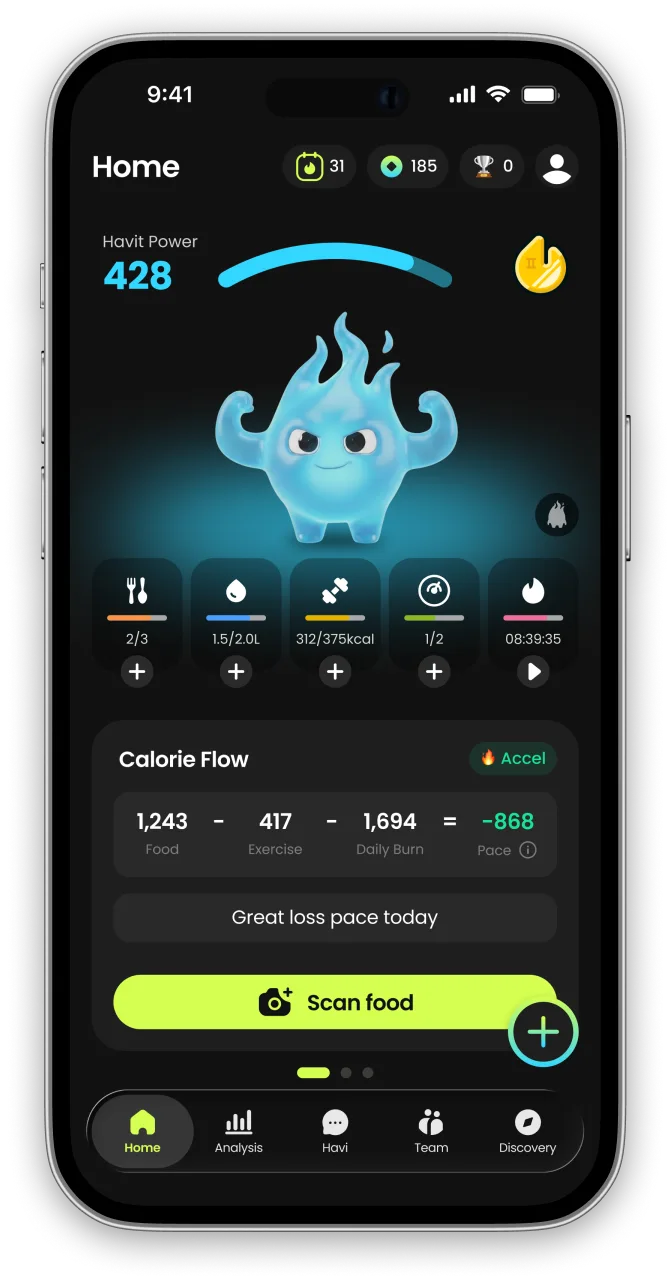
What is Havit?
Havit is an AI health companion for weight loss that protects muscle.
Unlike calorie-only trackers, Havit connects AI body-composition estimates, nutrition, hydration, sleep, steps, cycle, mood, and GLP-1 medication in one daily routine — so progress is measured by body composition, not just the number on the scale. Daily missions turn established behavior-change techniques into small repeatable actions, drawing on expertise from professionals formerly at Juvis Diet, one of Korea’s leading metabolic clinics.
In Havit’s own analysis of 1,090 GLP-1 users, people who logged consistently built stronger habits than the general user base. Read the GLP-1 Habit Report
Havit works with or without GLP-1 medication. It is a wellness app, not a medical device; body-composition results are estimates.

Continue in the App
Personalized wellness with your own data


References
- Eccentric Loading for Tendinopathy: A Systematic Review and Meta-Analysis of Randomized Controlled Trials — British Journal of Sports Medicine, Malliaras P. et al., 2025
- Tendon Adaptation to Eccentric Loading: Ultrasound and Histological Findings — American Journal of Sports Medicine, Rio E. et al., 2024
- Optimizing Eccentric Training Volume for Achilles Tendinopathy: A Randomized Non-Inferiority Trial — Queen Mary University of London, British Journal of Sports Medicine, 2025
- Pain Monitoring During Eccentric Rehabilitation: Outcomes in 156 Patients — University of Melbourne, Journal of Orthopaedic & Sports Physical Therapy, 2025
- Tendinopathy Pathophysiology and the Continuum Model — La Trobe University, Cook J. & Purdam C., Sports Medicine, 2024 Update

