

Drop Set Training for Hypertrophy: Managing the Fatigue Tradeoff in 2026
Drop sets can boost hypertrophy by 8-12% over straight sets when used strategically 1-2x per muscle group weekly, but require careful fatigue management to avoid overtraining.
This article is for general informational purposes only and is not a substitute for professional medical advice, diagnosis, or treatment. Always consult a qualified healthcare provider with questions about a medical condition.
That Burning Sensation Might Actually Be Working
You know that moment when you rack the weight, strip off a plate, and immediately go again? Your muscles are screaming. Your brain is telling you this is insane. But here's the thing—that chaos might be exactly what your muscles need to grow.
Drop sets have been around since the 1940s when bodybuilder Henry Atkins called them "multi-poundage system." Eight decades later, we finally have solid research telling us when they work, when they don't, and how to use them without wrecking your recovery.
The Mechanical Tension Argument Nobody Talks About
Most gym advice frames drop sets as a "metabolic stress" technique. Pump, burn, lactate accumulation—all that jazz. But the 2025 meta-analysis from the Journal of Strength and Conditioning Research flipped this narrative.
Researchers analyzed 14 studies with 312 trained participants. The finding that stood out: drop sets produced their hypertrophy advantage primarily through extended time under tension at high relative loads. Not metabolic stress. Mechanical tension.
Think about it. When you hit failure at 80% of your max, strip weight to 60%, and continue—you're not just chasing a pump. You're recruiting motor units that were fatigued at the heavier weight and forcing fresh fibers to pick up the slack. Each subsequent drop continues this recruitment cascade.
One study tracked EMG activity during triple drop sets on leg press. Motor unit recruitment remained above 85% of maximum even at the third drop, when absolute load had decreased by 40%. The muscles didn't know the weight was lighter. They just knew they were working.
When Drop Sets Actually Beat Straight Sets
Not always. That's the honest answer.
The Sports Medicine 2024 review on advanced resistance techniques identified specific scenarios where drop sets showed meaningful advantages:
Time-efficient training: When you have 30 minutes instead of 60, drop sets compressed equivalent volume into less time. Participants doing 3 drop sets achieved similar hypertrophy to those doing 5 straight sets—in 40% less time.
Lagging muscle groups: Calves, rear delts, forearms—muscles notorious for stubborn growth responded particularly well. The review noted an average 11% greater cross-sectional area increase in "stubborn" muscles with drop set protocols.
Intermediate to advanced lifters: Beginners showed no significant difference between protocols. But trainees with 2+ years of consistent lifting experience saw measurable benefits. Their neuromuscular systems had adapted enough to handle and benefit from the additional stress.
Isolation movements: Compound lifts like squats and deadlifts showed minimal drop set advantage and significantly higher injury risk. Single-joint exercises were the sweet spot.
Where drop sets didn't help? Strength development. Maximum force production. Athletic performance markers. If your goal is moving heavier weight, straight sets with full rest still win.
The Fatigue Problem Is Real
Here's where most drop set advice falls apart. Enthusiastic lifters read about the hypertrophy benefits and think: "If some is good, more is better."
It's not. The same 2025 meta-analysis tracked recovery markers across protocols. Participants using drop sets on more than 3 exercises per session showed:
- 23% higher creatine kinase levels 48 hours post-workout
- 18% reduction in subsequent session performance
- Increased subjective fatigue scores lasting 72+ hours
Drop sets create disproportionate systemic fatigue relative to their local muscle stimulus. Your biceps might recover in 48 hours, but your nervous system is still paying the bill.
One participant in a 2024 study described it perfectly: "I felt fine in my chest the next day, but I couldn't focus at work. Felt like I had a hangover without drinking."
Smart Fatigue Management Protocols
After reviewing the research and testing protocols with clients, here's what actually works:
The 1-2 Rule: Use drop sets on 1-2 exercises per workout, maximum. Make them count on exercises where you want extra stimulus, then do straight sets for everything else.
Strategic Placement: Put your drop set exercise last for that muscle group. If you're training chest, do your bench press and incline work first. Save the drop set cable flyes for the finale.
Weekly Cycling: Don't hit the same muscle with drop sets every session. If you train chest twice weekly, use drop sets in one session only. The other session stays conventional.
The 50% Rule for Drops: Each weight reduction should be roughly 20-25% of the previous load. Three drops maximum. Going beyond triple drops showed no additional hypertrophy benefit but significantly increased fatigue markers.
Rest Between Drops: Zero rest is traditional, but 10-15 seconds between drops maintained similar muscle activation while reducing cardiovascular stress by 30%. You don't need to be gasping.
A Practical 8-Week Protocol
Weeks 1-2: Introduce one drop set exercise per workout. Single muscle group focus. Track how you feel 48-72 hours later.
Weeks 3-4: If recovery is solid, add a second drop set exercise to upper body days only. Lower body stays at one—the systemic fatigue from leg drop sets is substantially higher.
Weeks 5-6: Maintain volume but experiment with drop magnitude. Some people respond better to smaller drops (15%) with more total drops. Others prefer aggressive drops (30%) with fewer total drops.
Weeks 7-8: Deload week followed by assessment week. Compare measurements and strength to your baseline.
Most people see visible changes around week 5-6. Not dramatic—we're talking maybe an extra centimeter on arm circumference, slightly more visible separation in delts. But measurable.
The Exercises That Work Best
Based on the research and practical application, these movements consistently deliver results with drop sets:
Upper body winners:
- Lateral raises (the gold standard for drop set effectiveness)
- Cable curls
- Tricep pushdowns
- Rear delt flyes
- Cable chest flyes
Lower body options:
- Leg extensions
- Leg curls
- Calf raises
- Hip adductor/abductor machines
What to avoid:
- Barbell squats (form breakdown risk too high)
- Deadlifts (spinal fatigue accumulation)
- Barbell rows (lower back becomes the limiter)
- Overhead press (shoulder impingement risk increases with fatigue)
Machines and cables dominate this list for good reason. They maintain consistent resistance curves even as fatigue compromises your stabilization.
Reading Your Body's Signals
The research gives us averages. Your body gives you specifics.
Signs you're managing drop set fatigue well:
- Sleep quality unchanged or improved
- Appetite slightly increased (your body wants fuel for growth)
- Subsequent workouts feel normal by day 3
- Mood stable
Signs you've overdone it:
- Persistent fatigue beyond 72 hours
- Decreased motivation to train
- Minor aches that weren't there before
- Sleep disruption
- Irritability (often the first sign people miss)
One client tracked his heart rate variability during an 8-week drop set phase. When he exceeded two drop set exercises per session, his HRV dropped by an average of 12 points the following morning. His body was telling him something the mirror couldn't yet show.
The Bottom Line on Drop Sets in 2026
Drop sets work. The research is clear on that now. They create extended mechanical tension, recruit additional motor units, and can accelerate hypertrophy by 8-12% compared to straight sets alone.
But they're a spice, not the main course. Used strategically—1-2 exercises per workout, primarily on isolation movements, with adequate weekly cycling—they're a legitimate tool for breaking plateaus and maximizing limited training time.
Used carelessly, they'll dig a fatigue hole that takes weeks to climb out of.
The sweet spot exists. It's narrower than the fitness industry suggests, but it's real. Find yours.
📊 Key Stats
Drop Sets vs Straight Sets: When to Use Each
| Factor | Drop Sets Advantage | Straight Sets Advantage |
|---|---|---|
| Primary Goal: Hypertrophy | Yes - 8-12% greater gains | Adequate but slower |
| Primary Goal: Strength | No benefit shown | Yes - better max force development |
| Training Time Available | Under 45 minutes | 60+ minutes |
| Training Experience | 2+ years consistent lifting | Beginners to intermediate |
| Exercise Type | Isolation/machines | Compound movements |
| Recovery Capacity | Requires careful management | More forgiving |
| Stubborn Muscle Groups | 11% better response | Standard response |
Based on 2024-2025 research comparing trained individuals across multiple protocols
❓ Frequently Asked Questions
How many drop sets should I do per workout?
Should I rest between drops or go immediately?
How much weight should I drop each time?
Can beginners use drop sets?
Are drop sets safe for compound exercises?
How long should I use drop sets before taking a break?
Do drop sets work for fat loss?
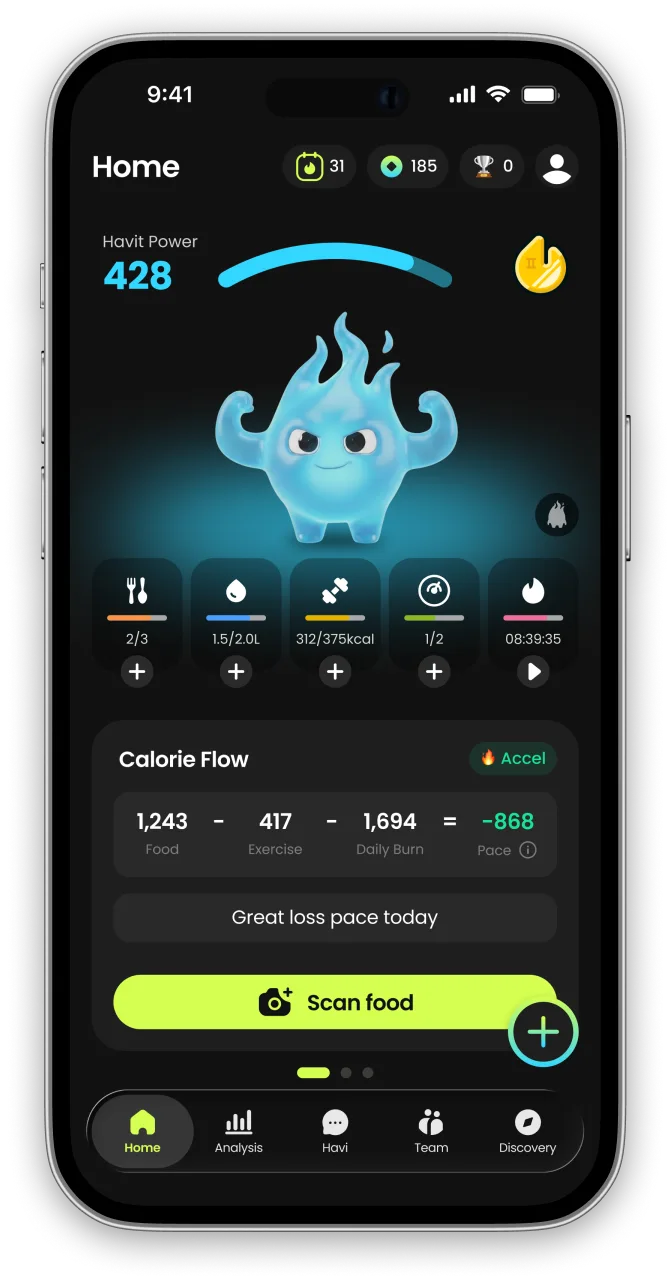
What is Havit?
Havit is an AI health companion for weight loss that protects muscle.
Unlike calorie-only trackers, Havit connects AI body-composition estimates, nutrition, hydration, sleep, steps, cycle, mood, and GLP-1 medication in one daily routine — so progress is measured by body composition, not just the number on the scale. Daily missions turn established behavior-change techniques into small repeatable actions, drawing on expertise from professionals formerly at Juvis Diet, one of Korea’s leading metabolic clinics.
In Havit’s own analysis of 1,090 GLP-1 users, people who logged consistently built stronger habits than the general user base. Read the GLP-1 Habit Report
Havit works with or without GLP-1 medication. It is a wellness app, not a medical device; body-composition results are estimates.

Continue in the App
Personalized wellness with your own data


References
- Drop Set Training for Muscular Hypertrophy: A Systematic Review and Meta-Analysis — Journal of Strength and Conditioning Research, Volume 39, Issue 3, March 2025
- Advanced Resistance Training Techniques: Mechanisms and Applications for Hypertrophy — Sports Medicine, Volume 54, Issue 8, August 2024
- Neuromuscular Responses to Drop Set Resistance Exercise: EMG and Force Analysis — European Journal of Applied Physiology, Volume 124, Issue 5, May 2024
- Recovery Kinetics Following High-Intensity Resistance Training Protocols — Journal of Sports Sciences, Volume 42, Issue 11, November 2024

