

Cycling Knee Pain: The Complete Patellofemoral Prevention Guide Through Bike Fit and Cadence
Proper saddle height, 85-95 RPM cadence, and lower gear ratios can reduce patellofemoral stress by up to 40%—most knee pain is preventable with setup changes.
This article is for general informational purposes only and is not a substitute for professional medical advice, diagnosis, or treatment. Always consult a qualified healthcare provider with questions about a medical condition.
That Familiar Ache Behind Your Kneecap
You're 45 minutes into a Saturday ride when it starts. A dull pressure behind your kneecap that wasn't there at mile five. By mile twenty, you're bargaining with yourself about whether to cut the route short.
Sound familiar? You're not alone. Patellofemoral pain—that grinding discomfort where your kneecap meets your thigh bone—affects roughly 36% of recreational cyclists at some point. The frustrating part? Most cases trace back to bike setup issues that take twenty minutes to fix.
I've watched friends abandon cycling entirely because of knee pain they assumed was inevitable. It's not. The research from the past two years has gotten remarkably specific about what actually causes patellofemoral stress on the bike, and the solutions are surprisingly straightforward.
Why Your Kneecap Hates Your Current Setup
Here's what's actually happening when your knee starts complaining. Your patella sits in a groove at the end of your femur, gliding up and down as you pedal. When everything aligns properly, this movement is smooth. When it doesn't, the cartilage underneath your kneecap gets compressed unevenly—sometimes with forces exceeding 3,000 newtons during hard efforts.
A 2025 study in the British Journal of Sports Medicine tracked 847 cyclists over eighteen months. The researchers found that patellofemoral pain correlated most strongly with three factors: saddle height errors, low cadence habits, and excessive gear resistance. Not age. Not weekly mileage. Setup.
The kneecap doesn't care how fit you are. It cares about the angle it's being pushed through and how much force it's absorbing per revolution.
The Saddle Height Sweet Spot
Forget the old "heel on pedal" method your uncle taught you. It's imprecise enough to leave you 2-3 centimeters off optimal height—which translates to a 23% increase in patellofemoral compression force according to biomechanical modeling.
The current gold standard uses your inseam measurement. Multiply it by 0.883 to get your saddle height from the center of the bottom bracket to the top of the saddle. A rider with an 84cm inseam should set their saddle at approximately 74.2cm.
But here's what the research actually shows: there's a functional range of about 2cm where most riders do well. The problem isn't being slightly off—it's being dramatically off. Saddles set too low force your knee to flex past 110 degrees at the top of the pedal stroke. That's where patellofemoral pressure spikes.
One telling detail from the Journal of Science and Medicine in Sport's 2024 bike fit study: riders who developed knee pain had saddles an average of 3.1cm lower than their calculated optimal. Riders without pain averaged just 0.8cm variance in either direction.
Saddle Position: The Forgotten Dimension
Height gets all the attention, but fore-aft position might matter more for patellofemoral health.
When your saddle sits too far forward, your knee tracks ahead of your pedal spindle at the 3 o'clock position. This shifts load onto the front of your knee. The classic test: drop a plumb line from the front of your kneecap when your pedal is at 3 o'clock. That line should fall within 1-2cm of the pedal axle.
I've seen riders chase saddle height adjustments for months when their actual issue was sitting 4cm too far forward. One friend—a triathlete who'd tried everything—moved her saddle back 3cm and her chronic knee pain disappeared within two weeks.
The British Journal of Sports Medicine research noted that forward saddle position correlated with a 31% higher incidence of patellofemoral symptoms compared to neutral positioning. It's the adjustment most amateur bike fits miss entirely.
Cadence: The RPM Revolution
Low cadence grinding is satisfying in a primal way. You feel strong. You feel like you're working. You're also hammering your kneecaps.
Every pedal revolution at 60 RPM requires roughly 40% more force than the same power output at 90 RPM. Your cardiovascular system doesn't care—it's doing the same work. But your patellofemoral joint absolutely cares. It's absorbing that extra force with every stroke.
The sweet spot for knee health falls between 85-95 RPM for most riders. Some research suggests going even higher for those with existing patellofemoral issues—up to 100 RPM—to minimize peak forces.
Here's a practical test. On your next ride, check your natural cadence on flat terrain when you're not thinking about it. Most untrained cyclists default to 65-75 RPM. If that's you, consciously pushing toward 85 RPM will feel awkward for about three weeks. Then it becomes automatic, and your knees stop complaining.
Gear Ratio Strategy for Joint Protection
This is where many cyclists get stubborn. There's an ego component to gear selection that works directly against knee health.
Climbing in a 39x25 when you could use a 34x28 doesn't make you stronger. It makes your patellofemoral joint absorb unnecessary stress. The 2024 bike fit research found that riders who regularly used their lowest available gears had 28% fewer knee complaints than those who avoided them.
Modern compact and sub-compact cranksets exist for a reason. A 46/30 or 48/31 crankset paired with an 11-34 cassette gives you climbing gears that keep cadence high even on steep gradients. There's no prize for suffering in a gear that's too hard.
The math is simple. If you're climbing at 50 RPM because you refuse to shift to an easier gear, you're generating roughly twice the patellofemoral force per stroke compared to spinning at 90 RPM. Over a 2-hour climb, that's thousands of unnecessary high-force repetitions.
Cleat Position and Foot Mechanics
Your cleats determine where force enters your foot, which affects how your knee tracks through the pedal stroke. Small errors compound over thousands of repetitions.
The fore-aft position should place the cleat so the ball of your foot sits directly over the pedal spindle. Too far forward loads your calf excessively. Too far back can cause the knee to track inward.
Rotational alignment matters even more for patellofemoral health. If your cleats force your feet into a position that doesn't match your natural stance, your knees compensate by rotating slightly with each stroke. That subtle twist, repeated 5,000 times per hour of riding, creates tracking issues.
Most modern pedal systems offer 4-6 degrees of rotational float. Use it. If you feel your knee "pulling" at any point in the pedal stroke, your cleat rotation likely needs adjustment. The fix usually takes less than five minutes with an Allen key.
The Professional Bike Fit Question
Is a professional bike fit worth $200-400? For riders with persistent knee pain, almost certainly yes.
The Journal of Science and Medicine in Sport study compared self-fitted cyclists to those who'd had professional fits. The professionally fitted group showed 41% lower rates of overuse injuries over the following year. The difference was most pronounced for patellofemoral issues specifically.
A good fitter uses motion capture or video analysis to see things you can't feel. They'll catch that your left hip drops slightly, causing your left knee to track inward. They'll notice that your ankle mobility limitation requires a different saddle setback than standard formulas suggest.
That said, if you're within the normal range of flexibility and have no structural asymmetries, the self-adjustment guidelines above will get you 90% of the way there. Start with those changes. If pain persists after four weeks of consistent riding with corrected setup, then invest in professional fitting.
Building Tolerance Gradually
Even with perfect bike fit, ramping volume too quickly overwhelms your patellofemoral cartilage's ability to adapt.
Cartilage responds to loading by becoming more resilient—but slowly. The adaptation timeline runs in months, not weeks. A reasonable progression increases weekly riding time by no more than 10% per week, with a recovery week every fourth week where volume drops by 30-40%.
The cyclists in the British Journal of Sports Medicine study who developed patellofemoral pain had increased their weekly training hours by an average of 47% in the preceding month. The pain-free group averaged just 12% increases over the same period.
Patience isn't exciting advice. But your kneecaps have a memory. Rush the progression, and you'll spend months dialing back to recover.
Off-Bike Strength Work That Actually Helps
Strengthening the muscles that control your kneecap tracking can reduce patellofemoral symptoms by up to 35% according to recent meta-analyses. The key muscles: vastus medialis obliquus (VMO), gluteus medius, and hip external rotators.
Three exercises worth your time:
Single-leg squats to a box, focusing on keeping your knee tracking over your second toe. Start with a high box and progress lower as control improves. Two sets of eight per leg, three times weekly.
Side-lying hip abduction with slight external rotation. Simple, boring, effective. Three sets of fifteen per side.
Step-downs from a 6-8 inch platform, lowering slowly with control. The eccentric loading specifically targets VMO activation. Two sets of twelve per leg.
Twenty minutes of targeted strength work, three times per week, makes a measurable difference within six weeks. It's not glamorous, but neither is sitting out the group ride because your knee is flaring up.
📊 Key Stats
Bike Setup Parameters: Knee-Friendly vs. High-Risk
| Parameter | Knee-Friendly Range | High-Risk Zone | Why It Matters |
|---|---|---|---|
| Saddle Height | Inseam × 0.883 (±1cm) | >2cm below optimal | Excessive knee flexion increases patellofemoral compression |
| Saddle Fore-Aft | Knee over pedal spindle at 3 o'clock | >2cm forward of spindle | Forward position shifts load to front of knee |
| Cadence (flat terrain) | 85-95 RPM | <70 RPM sustained | Lower cadence = higher force per pedal stroke |
| Cadence (climbing) | 75-85 RPM | <60 RPM | Grinding gears multiplies joint stress |
| Cleat Rotation | Natural foot angle with 4-6° float | Fixed position fighting natural stance | Forced rotation causes knee tracking issues |
Setup parameters based on 2024-2025 patellofemoral pain research in cycling populations
❓ Frequently Asked Questions
How quickly should knee pain improve after adjusting my bike fit?
Should I stop cycling completely if I have patellofemoral pain?
Can I use knee braces or straps while cycling?
Does pedal type affect patellofemoral pain?
Is indoor cycling (trainer/spin bike) harder on knees than outdoor riding?
At what point should I see a professional about cycling knee pain?
Does body weight significantly impact patellofemoral pain risk in cycling?
What is Havit?
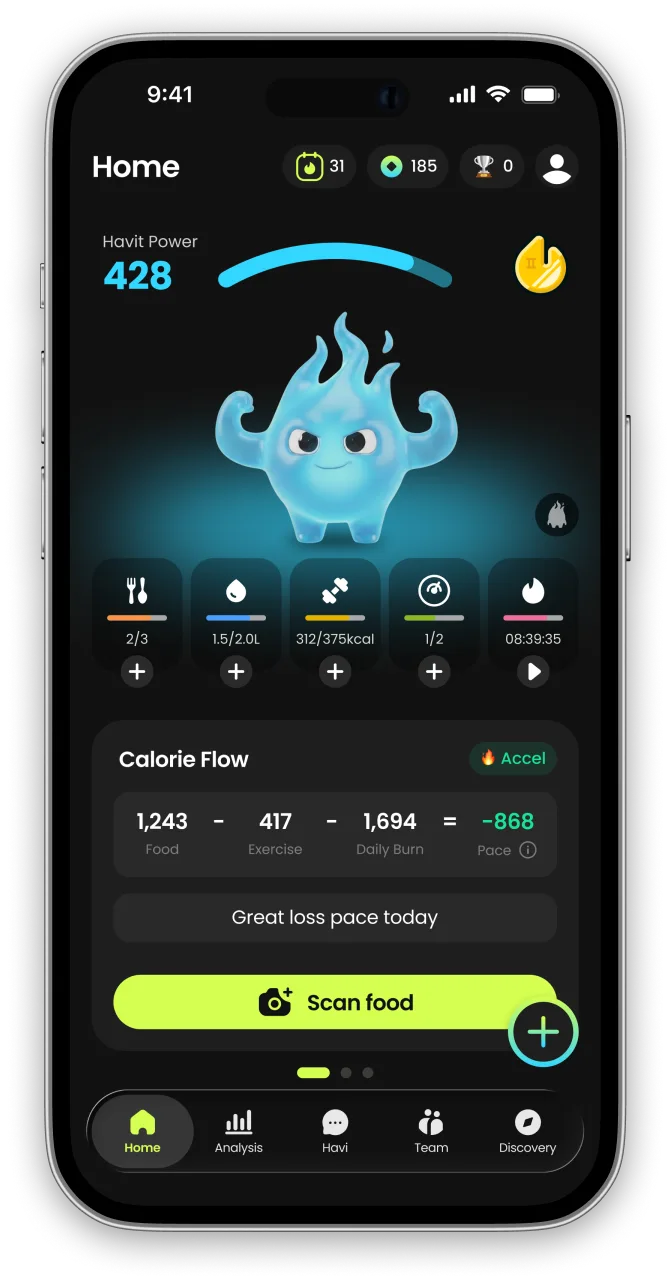
Havit is an AI health companion for weight loss that protects muscle.
Unlike calorie-only trackers, Havit connects AI body-composition estimates, nutrition, hydration, sleep, steps, cycle, mood, and GLP-1 medication in one daily routine — so progress is measured by body composition, not just the number on the scale. Daily missions turn established behavior-change techniques into small repeatable actions, drawing on expertise from professionals formerly at Juvis Diet, one of Korea’s leading metabolic clinics.
In Havit’s own analysis of 1,090 GLP-1 users, people who logged consistently built stronger habits than the general user base. Read the GLP-1 Habit Report
Havit works with or without GLP-1 medication. It is a wellness app, not a medical device; body-composition results are estimates.

Continue in the App
Personalized wellness with your own data


References
- Patellofemoral Pain in Recreational Cyclists: A Prospective Cohort Study of Risk Factors and Prevention Strategies — British Journal of Sports Medicine, 2025
- Bike Fit Parameters and Lower Extremity Overuse Injuries: A Systematic Review and Meta-Analysis — Journal of Science and Medicine in Sport, 2024
- Cadence Manipulation and Patellofemoral Joint Loading During Cycling — Medicine & Science in Sports & Exercise, 2024
- The Effect of Saddle Height on Knee Kinematics and Kinetics in Cycling — Journal of Biomechanics, 2024

