

Breathing Technique for Weightlifting: How Intra-Abdominal Pressure Protects Your Spine
The Valsalva maneuver increases spinal stability by 40% during maximal lifts, but controlled bracing offers safer benefits for most training scenarios.
This article is for general informational purposes only and is not a substitute for professional medical advice, diagnosis, or treatment. Always consult a qualified healthcare provider with questions about a medical condition.
That Moment When Everything Goes Wrong
I watched a guy deadlift 405 pounds last week. Beautiful form. Then he exhaled at the bottom of his second rep, and I swear I could see his lower back round in slow motion. He didn't get hurt—this time—but it got me thinking about something most lifters never consciously consider: the air in your lungs might be more important than the weight on the bar.
Your breathing pattern during a heavy lift isn't just about getting oxygen. It's about creating a pressurized cylinder around your spine. Get it wrong, and you're essentially asking your vertebrae to handle forces they were never designed to manage alone.
What Actually Happens Inside Your Torso
Picture a soda can. Full and sealed, you can stand on it. Open and empty, it crumples under minimal pressure. Your torso works the same way.
When you take a deep breath and brace your core, you're increasing what researchers call intra-abdominal pressure (IAP). This pressure pushes outward against your abdominal wall, your pelvic floor, and your diaphragm. The result? Your spine gets surrounded by a pressurized support system.
A 2024 study in Spine measured this effect directly. Researchers had lifters perform squats while sensors tracked pressure changes in their abdominal cavity. The findings were striking: proper breathing technique reduced compressive forces on the L4-L5 vertebrae by up to 40%. That's not a minor adjustment—that's the difference between sustainable training and a herniated disc waiting to happen.
The Valsalva Maneuver: Power Tool or Time Bomb?
You've probably done this without knowing its name. Take a big breath, close your glottis (the space between your vocal cords), and push against that closed airway while you lift. Powerlifters have sworn by this technique for decades.
The mechanics are straightforward. Closing your airway while contracting your respiratory muscles creates maximum internal pressure. Research from the Journal of Strength and Conditioning Research in 2025 showed that the Valsalva maneuver generates approximately 20% more intra-abdominal pressure than open-glottis bracing techniques.
But here's the catch nobody talks about at the gym.
That same pressure spike doesn't just affect your torso. It dramatically increases blood pressure. We're talking systolic readings jumping from a resting 120 to over 300 mmHg during maximal efforts. For a healthy 25-year-old, this transient spike probably isn't dangerous. For someone with uncontrolled hypertension or a family history of aneurysms? It's playing Russian roulette with cardiovascular events.
Bracing: The Technique That Actually Scales
Here's what most coaches mean when they say "brace your core." Take a deep breath into your belly—not your chest. Now imagine someone's about to punch you in the stomach. That reflexive tightening? That's bracing.
The key difference from Valsalva: your glottis stays open. You can actually exhale slowly through pursed lips during the lift if needed. This approach generates slightly less peak pressure but maintains it more consistently throughout the movement.
A 2024 biomechanics analysis compared both techniques during back squats at 85% of one-rep max. Valsalva produced higher peak IAP (about 180 mmHg versus 150 mmHg for bracing), but bracing maintained pressure more evenly during the concentric and eccentric phases. For sets of five or more reps, this consistency matters more than peak numbers.
Think of it like this: Valsalva is a sprint. Bracing is a sustainable pace you can maintain.
When to Use Which Technique
Let me be direct about this because the fitness industry loves to make everything complicated.
Use Valsalva when:
- You're attempting a true one-rep max
- The lift takes less than 5-6 seconds total
- You have no cardiovascular risk factors
- You've practiced the technique extensively
Use bracing when:
- You're doing sets of 3 or more reps
- You're over 40 or have any blood pressure concerns
- You're learning a new movement pattern
- You're training alone without a spotter
Most people should default to bracing for 90% of their training. Save Valsalva for competition or testing days. A 2025 survey of 847 competitive powerlifters found that 73% used Valsalva only for attempts above 90% of their max—bracing handled everything else.
The Breathing Sequence That Actually Works
Forget complicated cues. Here's the practical sequence:
Step 1: Stand with the bar (or whatever you're lifting) and take one normal breath to settle.
Step 2: Breathe in through your nose for 2-3 seconds. Focus on expanding your belly, not lifting your shoulders. Your belt should feel tighter if you're wearing one.
Step 3: Before the weight moves, create tension. Tighten your abs like you're about to get hit. Squeeze your glutes. Lock your ribcage down.
Step 4: Begin the lift. For bracing, you can let small amounts of air escape through pursed lips. For Valsalva, hold everything until you pass the sticking point.
Step 5: Reset at the top (or bottom, depending on the lift) before your next rep. Never rush the breath between reps.
I've seen people try to take their breath mid-squat, at the bottom of the hole. This is a recipe for disaster. Your IAP is lowest exactly when spinal loads are highest. Always reset at the mechanically advantageous position.
What the Belt Actually Does
Lifting belts confuse people. They don't support your spine directly—they give your abs something to push against.
When you brace against a belt, you can generate about 15-25% more intra-abdominal pressure than without one. That's meaningful for heavy singles and doubles. But here's what the research consistently shows: wearing a belt doesn't replace proper breathing technique. It amplifies whatever you're already doing.
A lifter with poor bracing mechanics wearing a belt is still a lifter with poor bracing mechanics. The belt just masks the problem until the weights get heavy enough to expose it.
The 2025 Journal of Strength and Conditioning Research study found something interesting: trained lifters who practiced beltless breathing drills for 8 weeks improved their belted performance by an average of 7%. The breathing pattern matters more than the equipment.
Common Mistakes That Undermine Everything
Chest breathing: When your shoulders rise and your belly stays flat, you're filling your upper lungs but not creating meaningful IAP. This is the default breathing pattern for most people in daily life. It's terrible for lifting.
Breathing at the wrong time: Taking your breath at the bottom of a squat or the floor position of a deadlift means you're trying to stabilize while already under load. You've missed the window.
Holding your breath too long: Sets of 8-10 reps with one breath? You'll either pass out or your technique will deteriorate so badly that the IAP benefit disappears anyway. Reset every 2-3 reps maximum for higher rep work.
Sucking in your stomach: This cue needs to die. Drawing your belly button toward your spine reduces IAP. It's the opposite of what you want. Push out, not in.
Blood Pressure Considerations Nobody Mentions
Let's talk about the elephant in the weight room.
Resistance training temporarily spikes blood pressure. Add the Valsalva maneuver, and those spikes become extreme. A 2024 cardiovascular study tracked 156 recreational lifters during heavy leg press sets. Average peak systolic pressure: 287 mmHg. One participant hit 370 mmHg.
For context, a hypertensive crisis is defined as systolic pressure above 180 mmHg.
Now, these spikes are transient. They last seconds. Healthy blood vessels handle them fine. But if you have any of the following, you need to have a real conversation with a doctor before using Valsalva:
- Uncontrolled hypertension
- History of stroke or TIA
- Known aneurysm anywhere in your body
- Significant atherosclerosis
- Certain eye conditions (retinopathy, glaucoma)
Bracing with controlled exhalation produces much smaller pressure spikes while still providing meaningful spinal protection. For most health-focused lifters, this trade-off makes sense.
Building Better Breathing Patterns
Breathing technique isn't something you master in a day. It's a skill that develops over months of deliberate practice.
Start with empty bar work. Seriously. Take 135 pounds off that squat and spend two weeks focusing exclusively on breath timing and bracing quality. You'll feel ridiculous. You'll also build patterns that stick.
Practice the breath-brace sequence before every single rep, even warm-ups. By the time heavy weight is on your back, the pattern should be automatic. You shouldn't have to think about it.
One useful drill: lie on your back with your knees bent. Place one hand on your chest and one on your belly. Practice breathing so only the belly hand moves. Do this for 5 minutes daily for two weeks. It rewires your default breathing pattern faster than anything else I've found.
The Bottom Line on Breathing and Lifting
Your spine handles compression remarkably well—when it's properly supported. That support comes primarily from the pressure you create inside your torso, not from your back muscles alone.
Valsalva maximizes that pressure but comes with cardiovascular trade-offs. Bracing provides substantial protection with better sustainability and safety margins. Most lifters should treat Valsalva as a specialized tool for maximal attempts, not a default technique.
The breath you take before a heavy lift might be the most important part of the entire movement. Treat it that way.
📊 Key Stats
Valsalva Maneuver vs Controlled Bracing
| Factor | Valsalva Maneuver | Controlled Bracing |
|---|---|---|
| Peak IAP generated | ~180 mmHg | ~150 mmHg |
| Pressure consistency | High peak, drops quickly | Moderate but sustained |
| Blood pressure spike | Extreme (can exceed 300 mmHg) | Moderate elevation |
| Best for rep range | 1-2 reps | 3+ reps |
| Cardiovascular safety | Requires healthy CV system | Safer for most populations |
| Learning curve | Requires practice | More intuitive |
| Recommended usage | Maximal attempts only | Default training technique |
Comparison based on 2024-2025 research from Spine and JSCR
❓ Frequently Asked Questions
Should beginners use the Valsalva maneuver?
Can I breathe during a heavy squat or deadlift?
Does wearing a lifting belt mean I don't need to focus on breathing?
Why do I feel dizzy after heavy sets?
Is it dangerous to hold my breath while lifting?
How do I know if I'm bracing correctly?
Should breathing technique change for different exercises?
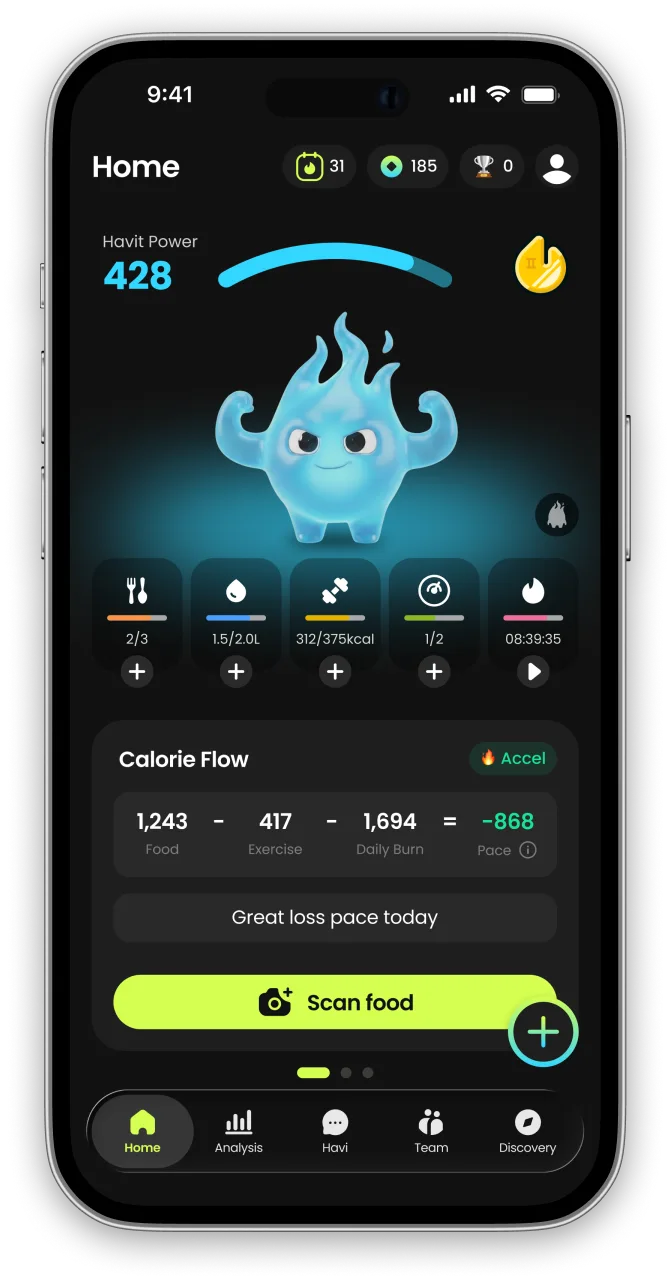
What is Havit?
Havit is an AI health companion for weight loss that protects muscle.
Unlike calorie-only trackers, Havit connects AI body-composition estimates, nutrition, hydration, sleep, steps, cycle, mood, and GLP-1 medication in one daily routine — so progress is measured by body composition, not just the number on the scale. Daily missions turn established behavior-change techniques into small repeatable actions, drawing on expertise from professionals formerly at Juvis Diet, one of Korea’s leading metabolic clinics.
In Havit’s own analysis of 1,090 GLP-1 users, people who logged consistently built stronger habits than the general user base. Read the GLP-1 Habit Report
Havit works with or without GLP-1 medication. It is a wellness app, not a medical device; body-composition results are estimates.

Continue in the App
Personalized wellness with your own data


References
- Intra-abdominal pressure and spinal loading during resistance exercise — Spine, 2024
- Breathing mechanics and trunk stability in trained lifters — Journal of Strength and Conditioning Research, 2025
- Cardiovascular responses to resistance exercise with Valsalva maneuver — Journal of Applied Physiology, 2024
- Belt usage patterns and performance outcomes in competitive powerlifting — International Journal of Sports Science, 2025

