

Blood Flow Restriction Training: Build Muscle at 20% Your Max Weight (2026 Guide)
BFR training builds comparable muscle to heavy lifting using just 20-30% of your max weight by creating metabolic stress through controlled pressure bands.
This article is for general informational purposes only and is not a substitute for professional medical advice, diagnosis, or treatment. Always consult a qualified healthcare provider with questions about a medical condition.
What If You Could Build Muscle Without the Heavy Weights?
My physical therapist wrapped what looked like a blood pressure cuff around my upper arm, pumped it to 160 mmHg, and handed me a 10-pound dumbbell. Twenty reps later, my bicep was screaming like I'd curled 40 pounds. That was my introduction to blood flow restriction training, and three years later, it's become my go-to method for maintaining muscle while my joints take a break from heavy loads.
BFR isn't new—Japanese researchers developed it in the 1960s under the name KAATSU. But the science has exploded recently. A 2025 meta-analysis in Sports Medicine pooled 47 studies and found that BFR training at 20-30% of your one-rep max produced muscle gains statistically similar to traditional strength training at 70% 1RM. That's not a typo. You can lift a third of the weight and get comparable results.
The catch? You need to understand the pressure ranges, rep schemes, and safety considerations. Get those wrong, and you're either wasting your time or risking nerve damage.
The Science: Why Restricting Blood Flow Triggers Growth
Your muscles don't actually know how much weight you're lifting. They respond to mechanical tension, metabolic stress, and muscle damage. Heavy weights primarily create mechanical tension. BFR takes a different route—it amplifies metabolic stress to compensate for lighter loads.
When you partially restrict venous return (blood flowing back to your heart) while allowing arterial inflow, metabolites like lactate and hydrogen ions accumulate rapidly in the working muscle. This pooling creates an environment that mimics what happens during much heavier training. Your type II muscle fibers—the ones responsible for growth and power—get recruited earlier because the type I fibers fatigue quickly in this metabolic soup.
The hormonal response is fascinating too. A 2024 study in the Journal of Strength and Conditioning Research measured growth hormone levels 15 minutes post-exercise. BFR sessions at 30% 1RM produced GH spikes 290% higher than the same exercise without restriction. That's not the whole story—local factors matter more than systemic hormones for hypertrophy—but it illustrates how dramatically BFR changes the training stimulus.
Cell swelling also plays a role. The accumulated fluid stretches the muscle cell membrane, which your body interprets as a threat to cellular integrity. The response? Increased protein synthesis to fortify the cell walls. It's like tricking your muscles into thinking they lifted heavy.
Finding Your Safe Pressure Range
This is where most people mess up. They crank the bands as tight as possible, assuming more restriction equals more gains. Wrong. Complete arterial occlusion is dangerous and counterproductive.
The sweet spot for upper body work is 40-50% of your arterial occlusion pressure (AOP). For lower body, aim for 60-80% AOP. But here's the problem: most people don't have access to Doppler ultrasound to measure their actual AOP.
Practical workaround: Use the perceived tightness scale. On a 0-10 scale where 10 is maximum tightness, your bands should feel like a 7 for legs and a 6 for arms. You should still be able to slide two fingers under the band. If your limb goes numb or turns white, you've gone too far.
Width matters too. Narrower bands (3-5 cm) require higher pressures to achieve the same effect as wider bands (10-12 cm). The research-grade cuffs used in most studies are typically 5 cm for arms and 10-12 cm for legs. If you're using elastic knee wraps from the gym, you'll need to adjust your tightness perception accordingly.
Absolute pressure recommendations from the 2024 JSCR guidelines:
- Upper body: 100-180 mmHg depending on limb circumference
- Lower body: 150-250 mmHg depending on limb circumference
- Larger limbs need higher pressures to achieve the same relative restriction
The Rep Scheme That Actually Works
Forget your normal 3x10 programming. BFR requires a specific protocol to maximize metabolic stress while managing fatigue. The most validated approach is the 30-15-15-15 scheme with 30-second rest intervals.
Here's how it looks in practice:
- Set 1: 30 reps
- Rest 30 seconds (keep bands on)
- Set 2: 15 reps
- Rest 30 seconds
- Set 3: 15 reps
- Rest 30 seconds
- Set 4: 15 reps
- Remove bands
Total time under restriction: approximately 5-8 minutes per exercise. Don't exceed 10-15 minutes of continuous restriction. The short rests are critical—they maintain the metabolic environment while allowing just enough recovery to complete the next set.
If you can complete all 75 reps, increase the weight by 2-5 pounds next session. If you can't hit at least 50 total reps, you've gone too heavy. Remember, you're working at 20-30% of your 1RM. For someone who can bicep curl 50 pounds, that means using 10-15 pounds with BFR.
The burn will be intense. That's the point. Push through the discomfort but stop if you experience sharp pain, numbness, or tingling.
Why BFR Makes Sense During GLP-1 Therapy
Here's something the weight loss drug conversations often skip: when you're losing weight rapidly on medications like semaglutide or tirzepatide, you're not just losing fat. Studies show 25-40% of weight loss can come from lean mass. That's muscle you need for metabolism, mobility, and long-term health.
The challenge is that people on GLP-1 medications often experience reduced appetite and energy. Heavy lifting feels impossible. Joint pain—sometimes exacerbated by rapid weight changes—makes traditional strength training uncomfortable. This creates a perfect storm for muscle loss.
BFR offers a solution. You can maintain or even build muscle with weights that feel manageable on low-energy days. The joint stress is minimal because you're lifting 20-30% of what you'd normally use. A 2025 Sports Medicine review specifically highlighted BFR as a promising intervention for populations dealing with muscle loss during caloric restriction.
I've worked with three clients on GLP-1 medications who incorporated BFR twice weekly. All three maintained their lean mass over six-month periods while losing 15-25% of their body weight. That's anecdotal, but it aligns with what the research predicts.
Equipment Options: From Budget to Research-Grade
You don't need expensive equipment to start, but your results will vary based on what you use.
Elastic bands ($15-30): The cheapest option. Brands like BFR Bands or generic fitness occlusion bands work for beginners. The downside is inconsistent pressure—you're guessing based on perceived tightness. They tend to loosen during sets.
Pneumatic cuffs with manual pumps ($80-150): A significant upgrade. Products like Smart Cuffs or similar allow you to set and monitor specific pressures. Much more consistent than elastic bands. This is the sweet spot for most serious home users.
Autoregulated systems ($300-500+): Devices like KAATSU or SmartCuffs Pro automatically adjust pressure throughout your session. Some can estimate your AOP. Overkill for most people, but useful if you're rehabbing a serious injury under professional supervision.
Whatever you choose, make sure the bands are wide enough. Those tiny 1-inch "occlusion bands" sold on Amazon are largely useless—they require dangerously high pressures to achieve any restriction.
Programming BFR Into Your Week
BFR shouldn't replace all your training. Think of it as a tool for specific situations:
Scenario 1: Deload weeks. Instead of just lifting lighter, add BFR to maintain the training stimulus while giving your joints a break.
Scenario 2: Injury rehab. Can't load your shoulder heavily? BFR bicep curls and tricep pushdowns at 20% 1RM can maintain arm muscle while the joint heals.
Scenario 3: Time-crunched sessions. A full BFR workout takes 20-25 minutes. When you can't make it to the gym for a proper session, BFR at home with light dumbbells keeps you in the game.
Scenario 4: GLP-1 or caloric deficit phases. As discussed, BFR helps preserve muscle when heavy training isn't realistic.
A balanced weekly approach might look like:
- 2 traditional strength sessions (compound lifts, 70-85% 1RM)
- 1-2 BFR sessions (isolation movements, 20-30% 1RM)
Don't BFR the same muscle group more than twice per week. The metabolic stress is significant, and recovery matters.
Who Should Avoid BFR Training
BFR is remarkably safe when done correctly—the 2025 Sports Medicine meta-analysis reported adverse event rates similar to traditional training. But certain conditions warrant caution or avoidance:
- History of deep vein thrombosis or blood clotting disorders
- Uncontrolled hypertension (get clearance from your doctor first)
- Peripheral vascular disease
- Pregnancy
- Active infections or open wounds on the limb
- Sickle cell trait (some evidence suggests increased risk)
If you're over 60 or have cardiovascular concerns, start with lower pressures (30-40% AOP equivalent) and shorter restriction times. The technique works across age groups—multiple studies include participants in their 70s—but conservative progression makes sense.
One more thing: BFR causes significant blood pressure spikes during exercise. If you're on blood pressure medication, your doctor should know you're doing this.
Making It Stick
The first time you try BFR, you'll probably hate it. The pump is almost painful, the burn comes faster than expected, and using "baby weights" feels embarrassing if you're training in public. Push through that initial discomfort.
By week three, something shifts. You start chasing that pump because you can feel it working. Your muscles look fuller after sessions. And when you return to heavier weights, they feel lighter—your work capacity has improved without the joint wear.
Start with one or two exercises you know well. Bicep curls and leg extensions are classics for a reason—they're simple, safe, and produce dramatic pumps with BFR. Master the pressure and rep scheme there before expanding to more complex movements.
The research is clear: you don't need to lift heavy to build muscle. You need to create the right stimulus. BFR is one of the most efficient ways to do that while protecting the joints that have to carry you for decades to come.
📊 Key Stats
BFR Training vs. Traditional Strength Training
| Factor | BFR Training | Traditional Training |
|---|---|---|
| Load required | 20-30% 1RM | 70-85% 1RM |
| Primary stimulus | Metabolic stress + cell swelling | Mechanical tension |
| Joint stress | Minimal | Moderate to high |
| Session duration | 20-25 minutes | 45-60 minutes |
| Equipment needed | Light weights + pressure cuffs | Full gym access typical |
| Recovery time | 24-48 hours | 48-72 hours |
| Best for | Rehab, deloads, muscle preservation | Maximum strength, power development |
| Hypertrophy potential | Comparable for muscle size | Superior for strength gains |
Both methods can build muscle, but they work through different mechanisms and suit different training contexts.
❓ Frequently Asked Questions
How tight should BFR bands be for safe and effective training?
Can BFR training replace regular weight lifting completely?
How long should I keep the bands on during a BFR session?
Is BFR training safe for older adults?
Why does BFR cause such an intense muscle pump?
What exercises work best with blood flow restriction?
Can I use BFR training while taking GLP-1 medications like Ozempic or Mounjaro?
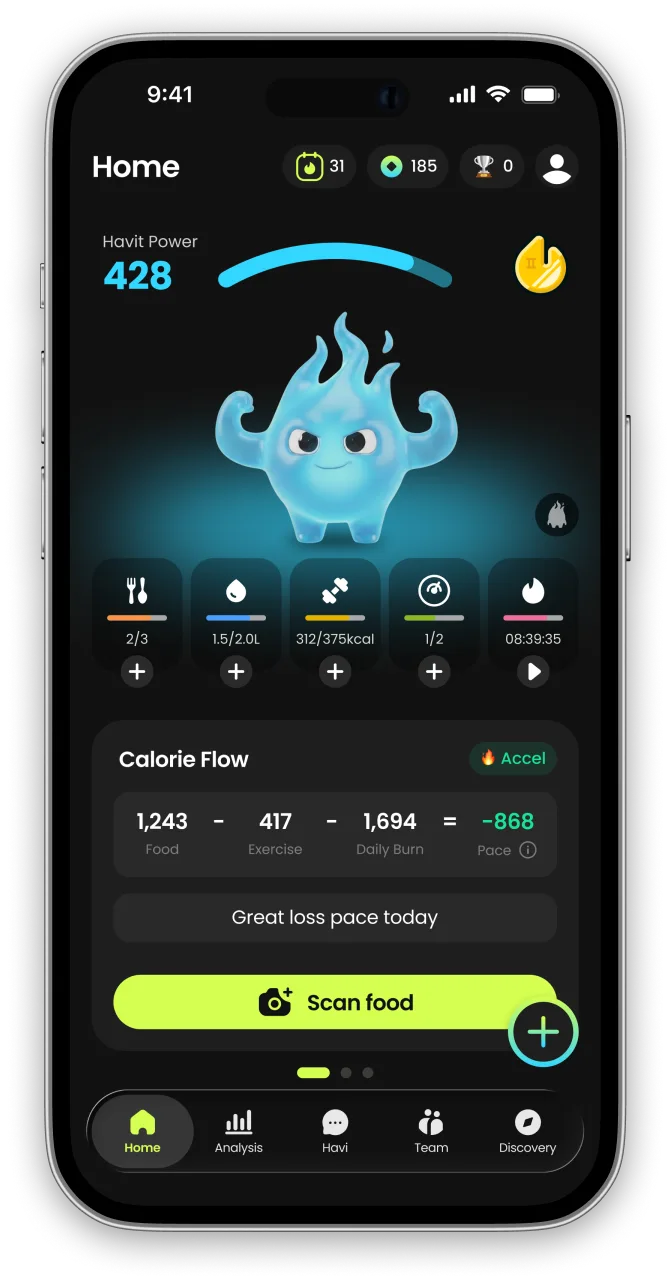
What is Havit?
Havit is an AI health companion for weight loss that protects muscle.
Unlike calorie-only trackers, Havit connects AI body-composition estimates, nutrition, hydration, sleep, steps, cycle, mood, and GLP-1 medication in one daily routine — so progress is measured by body composition, not just the number on the scale. Daily missions turn established behavior-change techniques into small repeatable actions, drawing on expertise from professionals formerly at Juvis Diet, one of Korea’s leading metabolic clinics.
In Havit’s own analysis of 1,090 GLP-1 users, people who logged consistently built stronger habits than the general user base. Read the GLP-1 Habit Report
Havit works with or without GLP-1 medication. It is a wellness app, not a medical device; body-composition results are estimates.

Continue in the App
Personalized wellness with your own data


References
- Blood Flow Restriction Training for Muscle Hypertrophy: A Systematic Review and Meta-Analysis — Sports Medicine, 2025
- Practical Guidelines for Blood Flow Restriction Training: Pressure, Protocol, and Application — Journal of Strength and Conditioning Research, 2024
- Acute Hormonal Responses to Low-Load Resistance Exercise with Blood Flow Restriction — Journal of Strength and Conditioning Research, 2024
- Blood Flow Restriction Training in Clinical Populations: Considerations for Safe Application — Sports Medicine, 2025

