

Morning vs Evening Workouts: What Your Circadian Rhythm Actually Wants in 2026
Morning workouts optimize fat burning and consistency, while evening sessions deliver 5-20% better strength and power performance due to peak core temperature.
This article is for general informational purposes only and is not a substitute for professional medical advice, diagnosis, or treatment. Always consult a qualified healthcare provider with questions about a medical condition.
The 6 AM Gym Is Lying to You (Sort Of)
I used to drag myself to 5:30 AM spin classes, convinced I was hacking my productivity. My body had other plans. Three months in, my squat numbers had actually dropped, I was constantly nursing minor tweaks, and I needed two espressos just to feel human. What nobody told me: the "best" workout time isn't about willpower. It's about temperature.
Your core body temperature swings by about 1°C throughout the day—sounds tiny, but that single degree changes everything about how your muscles contract, how quickly your nerves fire, and how much force you can generate. This isn't bro science. A 2024 Cell Metabolism study tracked 100 adults through morning and evening exercise protocols and found the metabolic responses were so different they might as well have been doing completely different activities.
So which is actually better? That's the wrong question. The right one: better for what?
Your Body's 24-Hour Performance Map
Let's walk through what's actually happening inside you from dawn to dusk.
Between 6-8 AM, cortisol surges to wake you up. This stress hormone gets a bad reputation, but morning cortisol is supposed to be high—it mobilizes fatty acids and primes you for action. The catch? Your core temperature is still at its daily low, sitting around 36.5°C. Your joints are stiff. Reaction time is sluggish.
By noon, things shift. Temperature climbs. Testosterone peaks in men (around 8 AM, actually, then gradually declines). Pain tolerance starts improving. Your coordination sharpens.
The magic window opens between 4-7 PM. Core temperature hits its daily maximum of roughly 37.5°C. Muscle blood flow increases. Protein synthesis rates climb. Your lungs function better—airway resistance drops by about 15% compared to early morning. Even your perception of effort decreases, meaning the same workout feels easier.
Then it all winds down. After 9 PM, melatonin starts creeping in, temperature drops, and your body shifts toward recovery mode.
Why Evening Wins for Strength (By a Lot)
Here's where it gets interesting. Chronobiology International published a meta-analysis in 2025 looking at time-of-day effects on resistance training. The numbers weren't subtle.
Evening lifters showed 5-20% greater peak power output compared to morning sessions. Grip strength? Higher by 5-8%. One study found bench press 1RM improved by an average of 3.5 kg when tested at 5 PM versus 7 AM—same subjects, same sleep, same nutrition.
The mechanism is straightforward. Warmer muscles contract faster. Nerve conduction velocity increases with temperature. Your joints have had all day to produce synovial fluid, so range of motion improves. Even your pain threshold rises—you can push harder before your brain screams stop.
I switched my heavy lifting days to 5 PM two years ago. Within six weeks, I added 10 kg to my deadlift without changing anything else. Not magic. Just physics.
But Morning Has a Secret Weapon
Before you trash your sunrise alarm, consider this: morning exercisers are 47% more likely to maintain their routine long-term, according to habit formation research. The gym at 6 AM doesn't compete with happy hours, late meetings, or the gravitational pull of your couch after a long day.
There's also the metabolic angle. That same Cell Metabolism study found morning exercise enhanced fat oxidation more effectively than evening sessions. Fasted morning cardio, in particular, tapped into fat stores more readily because insulin levels were low and fatty acid availability was high.
For steady-state cardio—think zone 2 running, cycling, or swimming—morning might actually be optimal. You're not chasing peak power output. You're building aerobic base, and consistency matters more than any single session's intensity.
One more thing: morning exercise seems to benefit blood pressure more significantly. A 2024 study in Hypertension tracked 200 adults and found morning exercisers showed greater 24-hour blood pressure reductions than evening exercisers doing identical workouts.
The Temperature Hack Nobody Talks About
What if you're stuck with morning gym slots but want strength gains? There's a workaround.
A proper warm-up can artificially raise your core temperature by 0.5-1°C, partially closing the gap with evening performance. But we're not talking about five minutes on the bike while scrolling Instagram. We're talking 15-20 minutes of progressive movement—dynamic stretches, light cardio, activation drills, then ramping sets of your main lift.
Researchers at Liverpool John Moores University found that extended warm-ups eliminated about 60% of the morning performance deficit in sprint cyclists. The subjects who warmed up for 20 minutes at 7 AM performed nearly as well as their baseline 5 PM tests.
Hot showers before training, warm training environments, and even caffeine (which raises core temperature slightly) can all contribute. Stack these together and you've manufactured your own mini-evening inside a morning workout.
Matching Workout Type to Time of Day
Let me give you a practical framework based on what the research actually supports.
Morning slots work best for: Zone 2 cardio, yoga, mobility work, lighter circuit training, and any workout where showing up consistently matters more than peak performance. If you're training for a marathon, morning long runs make sense—you're building volume, not chasing PRs.
Evening slots work best for: Heavy compound lifts, HIIT, sprint work, skill-based training (think Olympic lifts or gymnastics movements), and any session where you're testing limits. If you're peaking for a powerlifting meet, schedule your heaviest sessions after 4 PM.
The gray zone: Moderate-intensity resistance training, CrossFit-style workouts, and recreational sports can go either way. Your schedule, sleep quality, and personal chronotype (more on that next) matter more than circadian optimization for these.
Your Chronotype Changes the Equation
Not everyone's clock runs on the same schedule. True morning larks—about 25% of the population—peak earlier than average. Night owls, another 25%, peak later. The middle 50% are somewhere in between.
A 2023 study in Sports Medicine found that when athletes trained at their chronotype-preferred time, performance advantages shifted accordingly. Morning types showed smaller deficits in early sessions. Evening types showed even larger evening advantages than the general population.
How do you know your type? Forget online quizzes. Ask yourself: on a completely free day with no obligations, when do you naturally wake up and when do you feel most mentally sharp? If you're bouncing at 6 AM without an alarm, you're probably a morning type. If you're useless before 10 and hit your stride at 9 PM, you're an evening type.
Training against your chronotype consistently is fighting biology. You can do it—plenty of night owls have demanding early jobs—but know you're leaving some performance on the table.
What About Sleep Quality?
Evening training's biggest risk isn't performance—it's what happens after. Exercise raises core temperature and stimulates your sympathetic nervous system. Both interfere with sleep onset if the timing is wrong.
The general guideline is to finish intense exercise at least 2-3 hours before bed. A 2023 systematic review found that high-intensity training within 2 hours of sleep reduced sleep efficiency by 7% on average and delayed sleep onset by 14 minutes.
But here's the nuance: moderate exercise, even close to bedtime, didn't show the same effect. A 7 PM yoga session or easy jog is probably fine even if you're in bed by 9:30. It's the 8 PM HIIT class followed by a 10 PM bedtime that causes problems.
If evening is your only option and you're doing intense work, build in buffer time. Train at 6, eat dinner, let your body cool down, and you'll sleep fine.
Building Your Personal Schedule
Here's how I'd approach this if I were starting fresh.
First, audit your actual schedule. When can you realistically train 80% of the time? Theoretical optimal timing means nothing if life gets in the way. Consistency beats optimization every time.
Second, match intensity to timing. If you can only train mornings, put your cardio and lighter sessions there. Save the heavy stuff for weekends when you might have afternoon flexibility.
Third, invest in warm-ups. If morning strength work is unavoidable, those 15-20 minutes of preparation aren't optional—they're buying back the performance you'd otherwise lose.
Fourth, protect your sleep. Evening training is powerful, but not if it costs you an hour of sleep. The recovery you lose will erase the performance you gained.
Fifth, experiment for 4-6 weeks. Track your numbers. See how your body actually responds, not how the research says it should respond. Individual variation is real.
The Bigger Picture
I spent years optimizing the wrong things—supplements, rep schemes, periodization models—while ignoring the free variable sitting right in front of me. Training time isn't just a scheduling detail. It's a physiological lever.
That said, don't let this become another source of fitness paralysis. The best workout is still the one you actually do. If 5:30 AM is your only window and you're getting stronger, keep going. You're ahead of everyone still debating optimal timing from their couch.
But if you have flexibility? Use it. Match your training to your biology. Let your circadian rhythm do some of the work for you.
📊 Key Stats
Morning vs Evening Training: Performance and Practical Factors
| Factor | Morning (6-9 AM) | Evening (4-7 PM) | Winner |
|---|---|---|---|
| Peak power output | Baseline | +5-20% | Evening |
| Fat oxidation rate | Higher (low insulin) | Moderate | Morning |
| Flexibility/ROM | Reduced (cold muscles) | Optimal | Evening |
| Habit consistency | 47% better retention | More schedule conflicts | Morning |
| Reaction time | Slower | Fastest of day | Evening |
| Blood pressure benefits | Greater 24-hr reduction | Moderate | Morning |
| Sleep interference risk | None | Possible if late | Morning |
Performance factors favor evening; consistency and metabolic factors favor morning
❓ Frequently Asked Questions
Does morning or evening exercise burn more calories?
Can I train my body to perform better in the morning?
Is it bad to work out at different times each day?
How long should I warm up for morning strength training?
Does caffeine help morning workout performance?
What if I can only exercise late at night?
Are there different recommendations for cardio vs strength training timing?
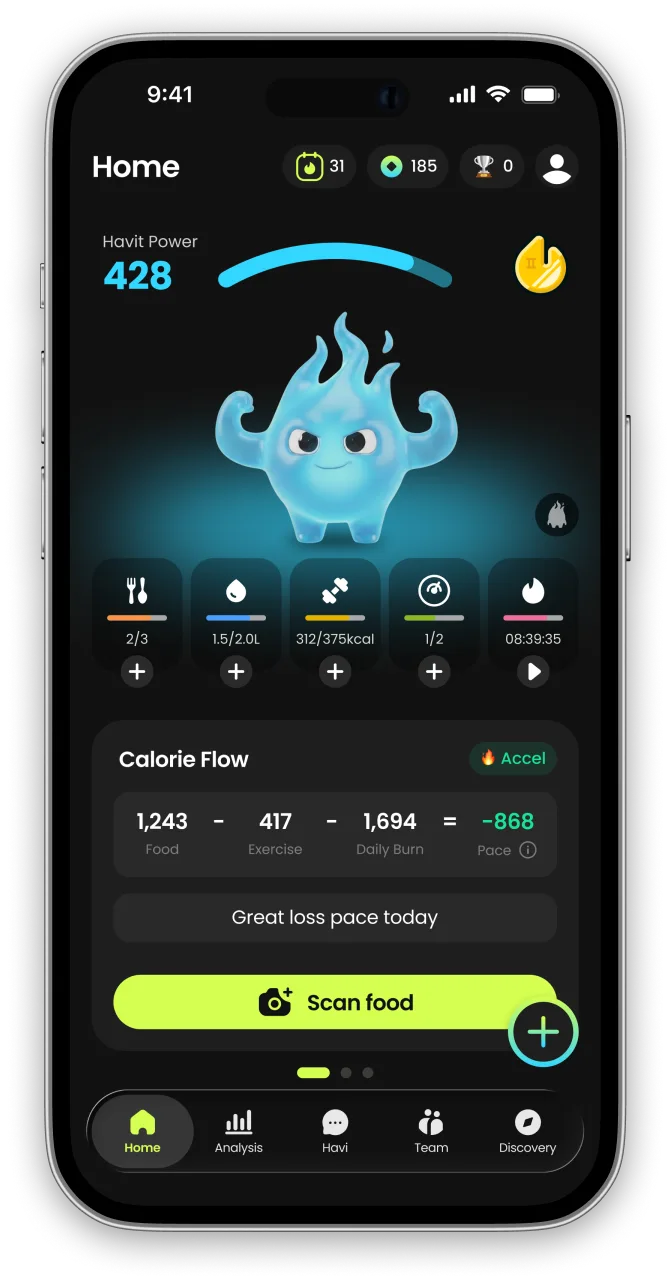
What is Havit?
Havit is an AI health companion for weight loss that protects muscle.
Unlike calorie-only trackers, Havit connects AI body-composition estimates, nutrition, hydration, sleep, steps, cycle, mood, and GLP-1 medication in one daily routine — so progress is measured by body composition, not just the number on the scale. Daily missions turn established behavior-change techniques into small repeatable actions, drawing on expertise from professionals formerly at Juvis Diet, one of Korea’s leading metabolic clinics.
In Havit’s own analysis of 1,090 GLP-1 users, people who logged consistently built stronger habits than the general user base. Read the GLP-1 Habit Report
Havit works with or without GLP-1 medication. It is a wellness app, not a medical device; body-composition results are estimates.

Continue in the App
Personalized wellness with your own data


References
- Time-of-day effects on exercise metabolism and performance adaptations — Cell Metabolism, 2024
- Circadian variation in resistance training outcomes: A systematic review and meta-analysis — Chronobiology International, 2025
- Effects of evening exercise on sleep: A systematic review and meta-analysis — Sleep Medicine Reviews, 2023
- Chronotype and athletic performance: Matching training to biological time — Sports Medicine, 2023
- Morning versus evening exercise and 24-hour blood pressure response — Hypertension, 2024

